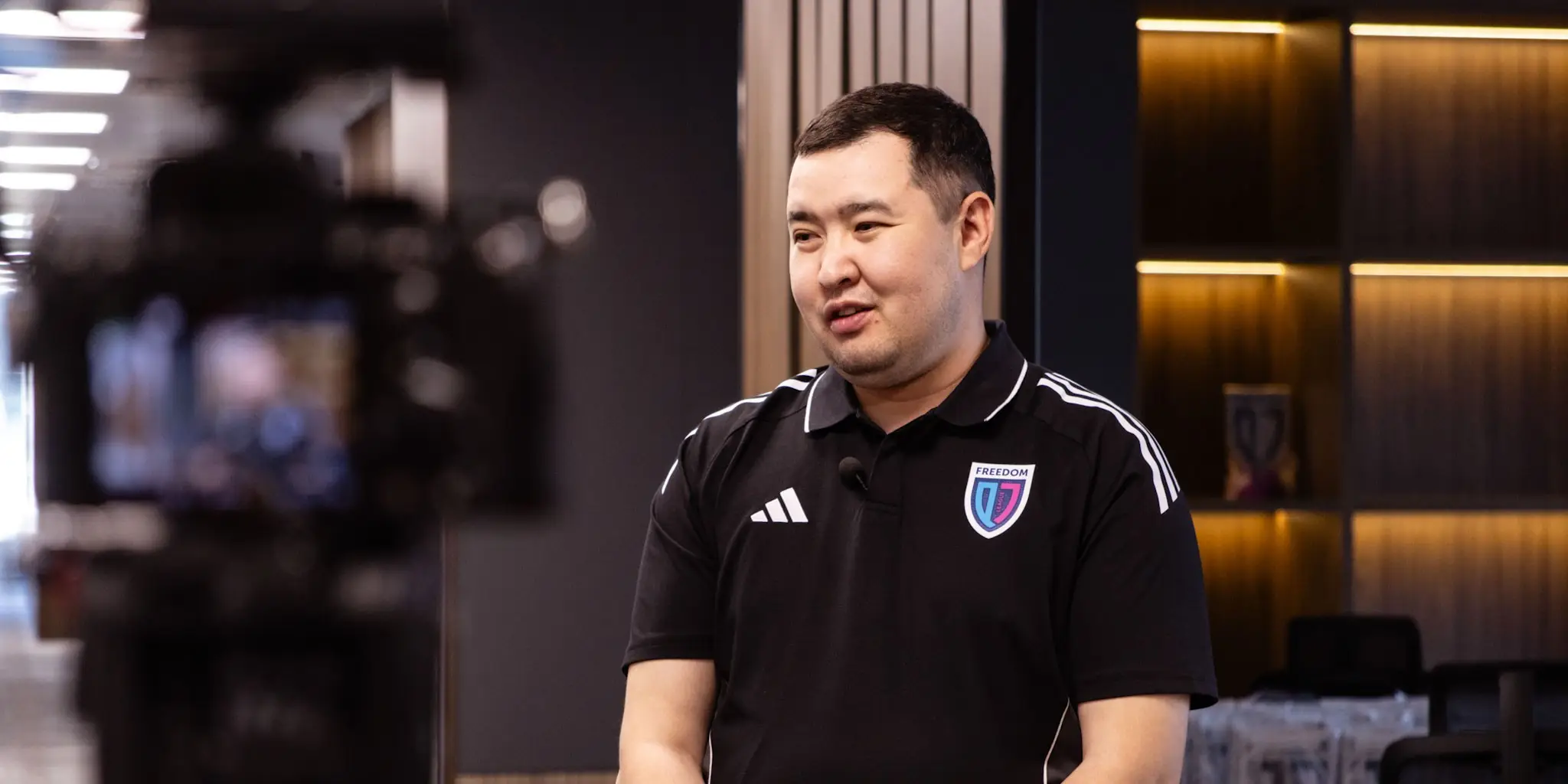
Bauyrzhan Sagyndyk, Head of the Sports and Analytical Unit of Freedom QJ League, reflected on the fourth season in an in-depth interview with the League’s press service.
The biggest season in the history of Freedom QJ League is behind us. How do you assess the work carried out by the Sports and Analytical Unit over the past year?
I see 2026 as a transitional but successful stage in the development of the Sports and Analytical Unit.
This was indeed our biggest season to date. Six tournaments were held, involving 66 teams and around 2,000 footballers. A competition of this scale places greater demands not only on its organisation but also on the quality of support provided across all areas of the League’s activities.
At the same time, 2026 was a period of major internal change for us. Almost 90% of the Sports and Analytical Unit’s staff were new. We launched new areas of work, brought in experienced specialists with relevant expertise, strengthened our team and began developing a new framework for cooperation across all SAU projects and areas of activity.
We paid particular attention to communication with the clubs. It is important for us not merely to set tasks or provide recommendations, but also to receive feedback, understand the actual needs of football centres, listen to their suggestions and work together to find solutions.
I think we managed to accomplish much of what we had planned for the year. At the same time, we understand that what has been done so far is not enough. We still need to build stable, long-term relationships between the League and the clubs based on trust, open communication, cooperation and mutual support.
Throughout the year, we also continued to develop our key areas of work: analytics, methodological support, coach education, physical preparation, digital platforms, mental preparation and women’s football. We expanded our use of modern technologies and improved the tools used to assess players and coaches.
We understand, however, that our role goes beyond collecting data, holding seminars or providing analytical reports. It is essential that all this work ultimately translates into better training and the development of young footballers.
For us, the main outcome of the year is therefore the beginning of a transition from individual projects and initiatives to a comprehensive system in which all areas are interconnected and serve a common goal: improving the quality of player and coach development and advancing football centres.
The Unit’s new three-year cycle has been marked by a shift from broad-based support to individual player development. What have been the main findings and changes in this area over the past year?
One of our key findings is that assessing a player solely on the basis of their current performance is not enough. We need to observe their development over several years, looking at how their playing attributes, physical capabilities, strengths and areas for improvement evolve.
This year, we worked extensively with the clubs to identify and support talented footballers. We established a pool of players who, in the opinion of the clubs and Sports and Analytical Unit experts, have exceptional potential for further development.
Following the initial selection, we assessed these players jointly. During the summer, the clubs organised individual training for them, aimed at developing their identified strengths and improving specific aspects of their game.
We then conducted a second round of assessments. As a result, new promising footballers were added to the list, while some players were removed. This is also an important outcome for us, as talent assessment should not be a one-off decision. A player’s potential must be continually reassessed in light of their progress and the results of the work carried out.
It is now particularly important for us to analyse the results: what contributed to the progress of some footballers, why others showed less pronounced improvement, which individual approaches worked and what factors need to be considered going forward. This experience will help us refine our system for identifying, assessing and supporting talented players.
At the same time, we are working on a comprehensive profile for each footballer, bringing together technical and tactical metrics, physical data, BigBro match analytics, GPS monitoring, medical data and psychological characteristics.
Particular emphasis will be placed on how these indicators change from season to season. This will allow us not only to establish a player’s current level but also to understand their development trajectory, assess their potential and identify areas for improvement in a timely manner.
Our strategic goal is to create a unified system that brings together all these data and enables us to develop individual recommendations and player development plans. Ultimately, we want every promising player to receive more targeted support and coaches and specialists to make decisions based on objective information.
As part of the new cycle, the Unit plans to build an extensive database of players’ physical performance metrics. How many footballers have already been tested, and how will these data be used going forward?
In 2026, we managed to test more than 2,500 players across age groups ranging from those born in 2008–2009 to those born in 2013. This is already a substantial volume of information that is helping us gradually build a picture of the physical development of young footballers at different ages.
We also developed a set of tests that, in our assessment, can establish the minimum required benchmarks for players’ key physical attributes. Standardising this process is essential to us, as it allows us to obtain comparable results and track footballers’ development over several years.
Another area of work is the use of data from the BigBro analytics platform. It provides information on the distance players cover during a match, including the distances covered in different intensity zones. This enables us to assess not only physical test results but also the actual physical demands placed on footballers during matches.
The next step is to combine testing results and match analytics into a unified system. We want to establish age-specific benchmarks, study changes in physical performance metrics, identify strengths and shortcomings, and use these data to improve the training process.
In the long term, this database should become one of the tools for assessing the physical development of young footballers in Kazakhstan and help us make better-informed decisions when preparing players for professional football.
This season, Pixellot cameras were installed at every League A stadium. Are coaches using video footage not only to analyse matches but also to review training sessions?
The installation of Pixellot cameras at all League A stadiums is an important step in the development of Freedom QJ League’s digital infrastructure.
I can say that coaches are already making regular use of this technology not only to record matches but also to film training sessions. This allows them to revisit sessions, analyse their content, assess how well the objectives were met and receive more objective feedback on their own work and the players’ actions.
It is essential for us that video becomes more than just an archive of matches and training sessions and serves as a fully fledged tool for learning and improving the training process.
At the same time, we understand that Pixellot has much greater potential. The next step is to integrate video footage more closely with analytical tools, develop coaches’ video analysis skills and foster a culture of regular video use in the educational process.
Our goal is to ensure that every coach can not only organise a training session but also analyse its effectiveness, identify mistakes and use the insights gained to further develop the team and individual players.
How is the FF Manager platform developing? What new features have been introduced, and how do you plan to promote it further?
One of the year’s important achievements was the continued development of FF Manager and the expansion of its functionality.
Today, the platform is used by all participants in Leagues A and B. We can also see that its value extends well beyond the League itself. Some clubs have already proposed extending the use of FF Manager to all age groups at their football centres, including teams that do not compete in Freedom QJ League. For us, this is a good indication of the demand for the platform.
Throughout the year, we added a range of new tools. In particular, we developed a built-in tool for creating and visualising football drills in FF Manager, allowing coaches to graphically model training exercises and game situations. We also introduced individual player development plans, a player tracker with training scheduling functionality, and tools for assessing players’ strengths and weaknesses and providing development recommendations.
We also introduced synchronisation with Pixellot cameras, the option to request analytical reviews of training sessions and matches through BigBro, the ability to create match plans and an updated match report template.
I would particularly highlight the integration of FF Manager with BigBro and physical testing results. Each footballer’s individual profile now displays their match statistics and test results. This is an important step towards creating a unified digital record of a player’s development, where their performances and physical metrics can be viewed in one place.
In addition, as part of the Player of the Future project, we are working with the clubs to develop a system for identifying and supporting talented footballers. We can now track promising players separately and obtain two assessments: one from the club that works with the player on a daily basis and one from Sports and Analytical Unit experts. This approach allows us to compare professional assessments, identify a player’s strengths and areas for development, and gain a more objective understanding of their potential.
FF Manager is thus gradually becoming more than just a training planning tool. It is evolving into a unified workspace for coaches that brings together planning, analytics, assessment and individual player development.
Our next task is to further integrate digital tools, including artificial intelligence technologies. In the future, we want coaches to be able to specify a particular objective and have the system use that input to help generate relevant training drills and solutions.
Our long-term goal is to turn FF Manager into a comprehensive digital ecosystem for football centres, used not only by Freedom QJ League teams but also by all age groups within the clubs.
U-15 teams joined the competitions this year. This generation has several seasons ahead of it within the League’s system. What do you hope to learn about these footballers by the end of the new cycle?
This generation is of particular interest to us because we have the opportunity to observe its development over several seasons. For the first time, we want to approach this process not merely as monitoring team performances, but as a long-term study of the development of an entire generation of footballers.
Ideally, by the end of the three-year cycle, we should have an individual profile for every player, be able to track their technical, tactical and physical development, and understand their strengths, areas for improvement and potential in the context of their playing position.
It is important for us to identify not only the most talented footballers but also those who show the greatest progress. We want to understand how players develop from year to year, which footballers are approaching professional standards and how many of them will ultimately be able to take the next step in their careers.
Another important aspect is assessing the work of the football centres themselves. With information on players’ development over several years, we will be better able to understand how effectively training is structured, which approaches deliver results and what factors influence footballers’ progress.
Ultimately, we want to gain an objective picture of this generation’s development, from each player’s individual metrics to an overall assessment of the quality of training at football centres. These findings will provide an important foundation for improving the entire youth football development system in Kazakhstan.
Which results do you consider the most significant when assessing the League’s effectiveness this year?
The results of the season paint a rather telling picture. Kazakhstan’s U-17 and U-19 national teams advanced beyond the first qualifying round and reached the second round of European Championship qualifying for the second consecutive year. This is an unprecedented achievement in the history of Kazakhstani youth football.
In addition, many footballers who have played in Freedom QJ League received call-ups and made their debuts for Kazakhstan’s senior and youth national teams this year. For us, this is an important indication that players progressing through the League’s system are gradually reaching a new level.
However, I would not separate player development from coach development. One of Freedom QJ League’s important tasks is to create a professional environment in which coaches have access to modern tools, analytics, methodological support, educational events and international expertise.
We understand that high-quality player development is impossible without high-quality coaching. Our task is therefore to create conditions in which both sides of this process can develop.
Ultimately, the League’s success for us is measured not only by the number of players it develops but also by the rising standards of the coaching community, the development of football centres and the growing number of footballers capable of representing Kazakhstan internationally.
The League has signed an agreement with City Football Group, while Borussia Mönchengladbach remains a partner. CFG representatives visited the regions and took part in SAU seminars. What does cooperation at this level offer the Sports and Analytical Unit? What are the prospects for further collaboration?
International cooperation is of great strategic importance to the Sports and Analytical Unit. We understand that football cannot develop in isolation, so it is important for us to study the experience of leading football organisations, adopt best practices and adapt them to the realities of Kazakhstani football.
Our partnership with City Football Group opens up new opportunities. First and foremost, it gives us access to international expertise, allows us to study CFG’s methodology, develop player development standards and raise the professional standards of our coaches and specialists.
It is particularly important that this cooperation goes beyond signing an agreement or holding individual events. Visits by CFG specialists to football centres make it possible to assess infrastructure, the organisation of training, the work of coaching staffs and management processes. This external perspective helps us better understand the strengths of our centres and identify areas for further development.
The participation of CFG specialists in SAU educational events also gives our coaches an opportunity to gain new knowledge, learn about modern methodologies and exchange practical experience.
Looking ahead, we expect to develop this partnership through regular visits, educational programmes, internships, methodological support and the continued improvement of operating standards at football centres.
Our international activities are not limited to CFG. We continue to cooperate with Borussia Mönchengladbach, expand our exchange of experience and make use of opportunities for methodological support.
I would, however, like to emphasise one fundamental point: our task is not to copy the methodology of CFG or other foreign clubs across every area. It is far more important for us to understand the logic behind their work, their philosophy, their decision-making principles and the mechanisms they use to develop players, coaches and football centres.
We must study international best practices, assess them critically and adapt them to the specific circumstances of Kazakhstani football. Our goal is not to replicate someone else’s model, but to build our own player development system based on international experience, a scientific approach and our national characteristics.
I believe that this is the approach that will allow us not merely to acquire knowledge but to build a sustainable model for football development in Kazakhstan.
What are the key objectives the Sports and Analytical Unit has set for 2027? And what is the main lesson you have drawn from the past season?
In 2027, we plan to continue developing the projects we have already launched, improve the way they are managed and seek new solutions that will contribute to the development of youth football in Kazakhstan.
One of our main priorities will be to further develop a systematic approach. It is important for us that every project has clear objectives, a well-defined management structure, designated specialists responsible for its implementation, measurable performance indicators and tangible results. We want not merely to launch new initiatives but to build a sustainable system that will continue to develop and bring practical benefits to football centres.
We will pay particular attention to new technologies, digital tools and modern approaches to player and coach development. We will also continue to improve our cooperation with clubs, establish effective communication and strengthen our joint work to develop football centres.
At the same time, it is essential for us to broaden our understanding of what football centre development entails. High-quality player development does not depend solely on the head coach. It is the result of the work of an entire team of specialists.
We therefore plan to pay greater attention to the development of football centre directors, coordinators, fitness coaches, medical staff and mental performance specialists. For each category, it is important to identify the necessary competencies, develop educational programmes and create conditions for professional growth.
In addition, we want to continue studying international experience, exploring new approaches and analysing the direction in which modern youth football is developing. It is important not only to follow global trends but also to understand which of them are genuinely applicable in our circumstances.
As for the main conclusion I have drawn from 2026, I would put it this way: many people in Kazakhstani football today have the right goals and objectives. Everyone wants to develop young footballers, raise coaching standards, achieve sporting results and win competitions.
However, I firmly believe that the main problem is not a lack of goals or a desire to develop football. The key question is how effectively we build a system to achieve those goals.
It is not enough simply to define what kind of player or coach we want to see in three to five years. We need to understand what steps must be taken, who is responsible for them, which specialists must be involved, what resources are needed and how we will assess the results.
This is precisely why I believe that the next stage in the development of youth football in Kazakhstan should involve a transition from individual initiatives and projects to systematic work based on a shared philosophy, standards, clear management mechanisms, accountability and continuity.
Our goals are largely the same. Our main task now is to learn how to build an effective system for achieving them.